Keep time under the rest
Tap quarter notes with your foot and count “one and two and.” Let the foot take “one” alone; play on “and.” Keep the preceding beat in a practice video.
Wait 300 ms at 100 BPM
The beat lasts 600 ms, so a straight eighth offbeat sits 300 ms after it. Try a left-hand downbeat at zero and the first right-hand note at 0.3 s.
Take away the guide gradually
Starting the clip on the melody erases the rest. After several passes, quieten the accompaniment and keep the same placement against your foot.
Build a loop with the silent downbeat intact
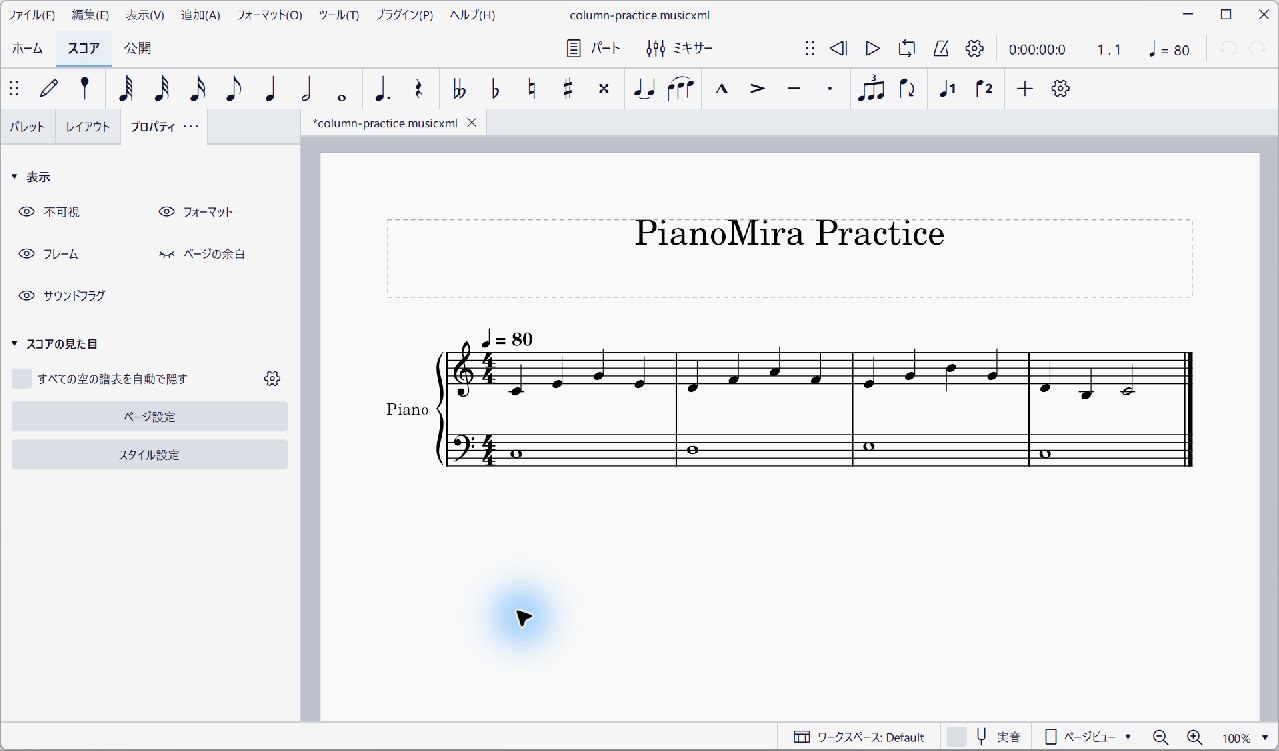
Use two beats in which the right plays rest–G–rest–A. A clip starting on G loses the rest and encourages you to hear G as a downbeat. Cut from the left-hand bass on the pulse to the corresponding pulse of the next cycle.
At 100 BPM the loop is 1.2 seconds. The left attacks at 0 and 0.6; the right at 0.3 and 0.9. On repetition there should also be 0.3 s between the last right note and the first left. The end of the last sounding note is not necessarily the correct loop boundary.
Remove the cue without losing the pulse
If the entrance works only with the bass, lower its volume while keeping the foot tap and the spoken “and”. Remove the voice next. Taking away one cue at a time reveals which one was carrying the timing.
Record the right hand alone and compare it with a steady click at the intended downbeats. A perfectly even line landing repeatedly on the clicks is still half a beat out for this exercise. Restart from the silent first pulse.
Why can an evenly played line still fail to sound offbeat?
Without an accent reference, the first audible note can become the perceived downbeat. Leave a bass pulse or click in the first cycle and remove it in the second. If your foot still lands in the same relation to the notes, you retained the pulse as well as the spacing.